
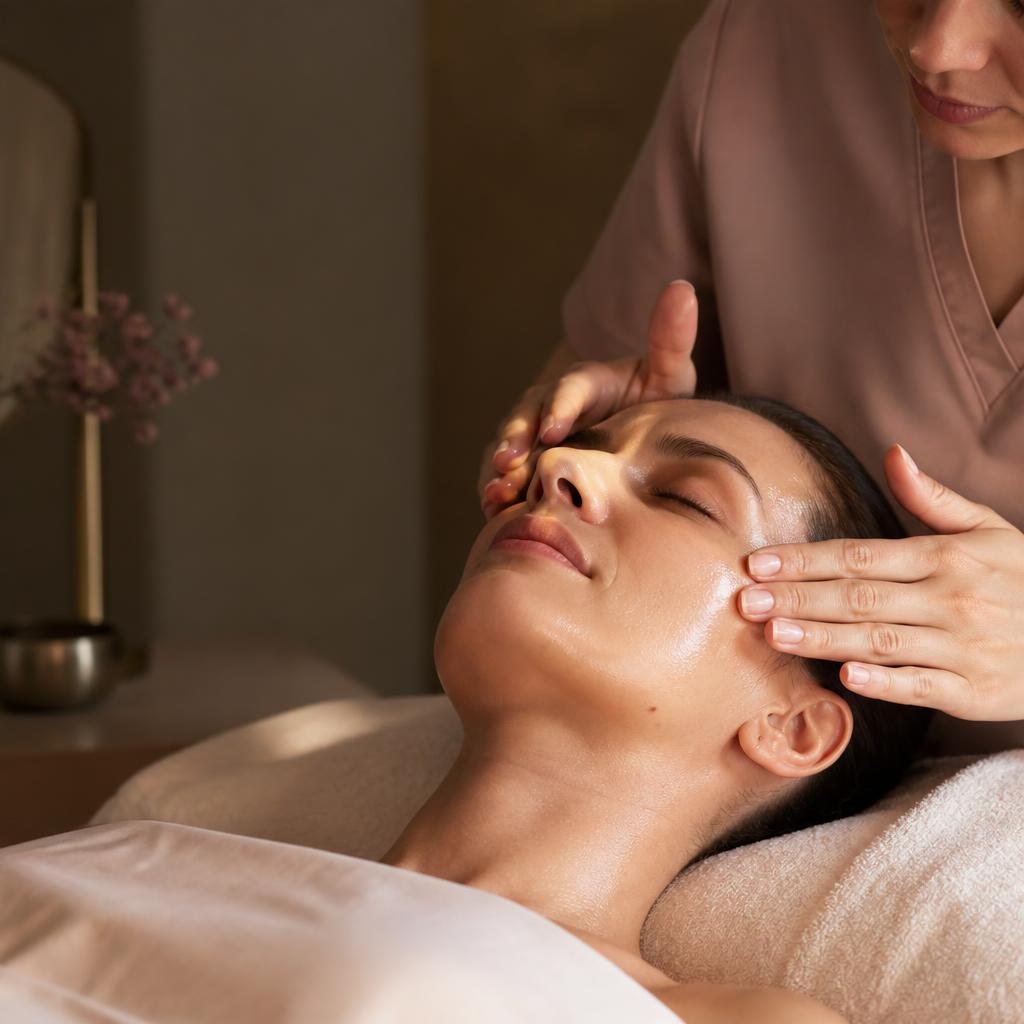
Then the questions start. Is this the point where you "need" an injectable? Everyone online seems to have an opinion, a before-and-after, and a recommendation.
The short answer: you don't have to decide today. Noticing a change in your skin does not mean you need a procedure. It means you need clear information and the right person to ask. This is how we help you decide a next conversation that fits your skin concerns and goals.
When online advice creates pressure
- Different goals. A facial is cosmetic care, not a replacement for a medical procedure.
- Realistic expectations. Discuss suitability, possible results, risks, alternatives, and aftercare with a qualified clinician before a medical procedure.[4]
- Medical concerns first. A new, changing, itching, or bleeding spot needs a dermatologist’s assessment rather than a salon treatment.[5]
Facials and medical procedures do different jobs
A medical aesthetic procedure is a separate clinical decision. The American Academy of Dermatology notes that safe cosmetic treatment requires “in-depth medical knowledge of the skin and what lies beneath.”[3] A clinical review of dermal fillers also notes that complications can occur even when injections are performed by experienced practitioners.[6] Neither a facial nor a procedure should be presented as a replacement for the other.
Option 1: A personalised hydrating facial (our Guinot Hydradermie 1000 treatment or HydraFacial where available)
Pros
- Non-invasive, with no medical procedure involved.
- Chosen for your skin after a consultation.
- May support a more hydrated or fresh-looking appearance, as described by Guinot; results vary.[1]
- Can be your first step. You can start with a facial and decide later whether to seek a separate medical consultation.
- Surface-level and cosmetic. It will not change facial structure or replace the effects of a medical procedure.
- Cannot diagnose a skin condition.
- Suitability and results depend on the treatment and your skin’s response.
- If you have recently had Botox or filler, ask your treating clinician when it is safe to have the specific facial you are considering. One clinic’s guidance about Hydrafacial after Botox is not a universal waiting period for other procedures or facials.[8]
Option 2: Our Guinot Hydradermie Lift treatment
Pros
- Non-invasive, with a lifted-looking cosmetic finish.
- Guinot describes facial muscle stimulation and a firmer-looking appearance; this is a manufacturer description, not a guaranteed outcome.[2]
- Can suit an event or a day when you want a refreshed look.
- The lifted look is cosmetic, not a promise of a lasting lift.
- Not a substitute for a medical treatment.
- Suitability depends on your skin and relevant health or treatment history, which we discuss before recommending it. Medical questions belong with your healthcare professional.
Option 3: A medical consultation (injectables, resurfacing, surgery)
Examples of injectable treatments
- Botulinum toxin (such as Botox): injected into selected facial muscles to temporarily reduce their movement and soften certain expression lines; it is not a filler.[12] [13]
- Hyaluronic-acid fillers: gel-like material injected beneath the skin to add fullness or smooth lines and folds.[12]
- Other filler materials: options include calcium hydroxylapatite and poly-L-lactic acid (PLLA); products differ in composition, effects, and duration.[12]
- Can address specific concerns a facial is not designed for.
- A qualified clinician can assess whether a procedure is suitable and perform it when appropriate.
- You can ask for a personal explanation of risks, realistic results, and alternatives.
- Risks vary by procedure. Dermal fillers, for example, have documented complications, including serious events reported even with experienced practitioners.[6]
- Follow-up, results, recovery, and upkeep vary by procedure and person.
- Reducing or removing fillers may require additional procedures with their own risks; some materials may be difficult or impossible to remove.[12]
A simple guide to choosing the next conversation
| Choose this if… | Start with |
|---|---|
| Cosmetic concern. You want to discuss dullness, tightness, uneven texture, or non-invasive facial care. | Vesna facial consultation |
| Comparing services. You want to weigh facial options, duration, or realistic results before booking. | Vesna facial consultation |
| Personal guidance. You want a recommendation for your skin and routine, without pressure to choose a course or add products. | Vesna facial consultation |
| Considering a procedure. You are thinking about an injectable, resurfacing treatment, or surgery and want to discuss suitability, risks, and alternatives.[4] | Medical consultation |
| Change in a spot or growth. It is new, changing, itching, or bleeding and needs assessment.[5] | Medical consultation, first |
| A non-invasive cosmetic approach. You’d like to start with a non-invasive facial and discuss what it may reasonably support before considering a medical procedure. | Vesna facial consultation |
| Recovery and ongoing care. You are considering a medical procedure and want to ask a clinician what recovery and maintenance may involve.[4] | Medical consultation |
| Relaxation and a feel-good experience. You’re looking for a calming facial treatment rather than a medical intervention. | Vesna facial consultation |
| Preparing for an event. You want to ask about timing and what a facial may reasonably support before a particular date. | Vesna facial consultation |
| Existing skin condition or prescribed treatment. You want to check whether a salon facial is appropriate alongside medical care.[4] | Your treating healthcare professional first |

What our clients say
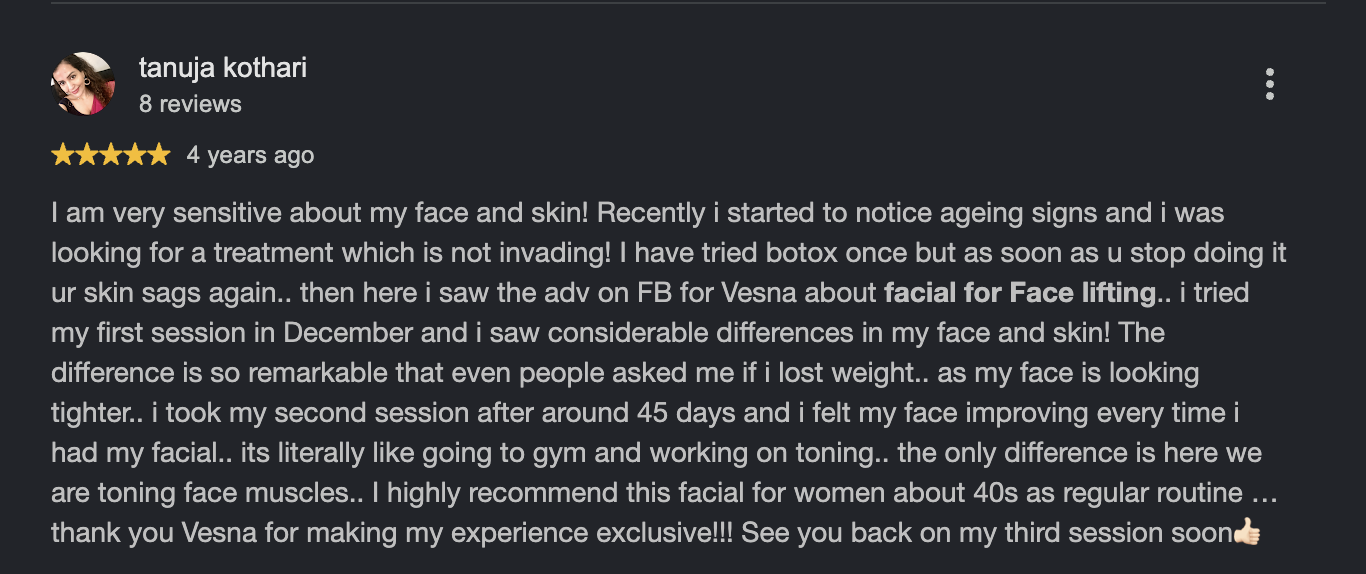
“I have tried botox once … then here i saw the adv on FB for Vesna about facial for Face lifting.. i tried my first session in December and i saw considerable differences in my face and skin! The difference is so remarkable that even people asked me if i lost weight.. as my face is looking tighter.. i took my second session after around 45 days and i felt my face improving every time i had my facial..”

“Absolutely loved my facial with Vesna, I cannot recommend her enough. She’s very knowledgeable, honest and has attention to detail 👌 I walked out feeling like I had a face lift!”
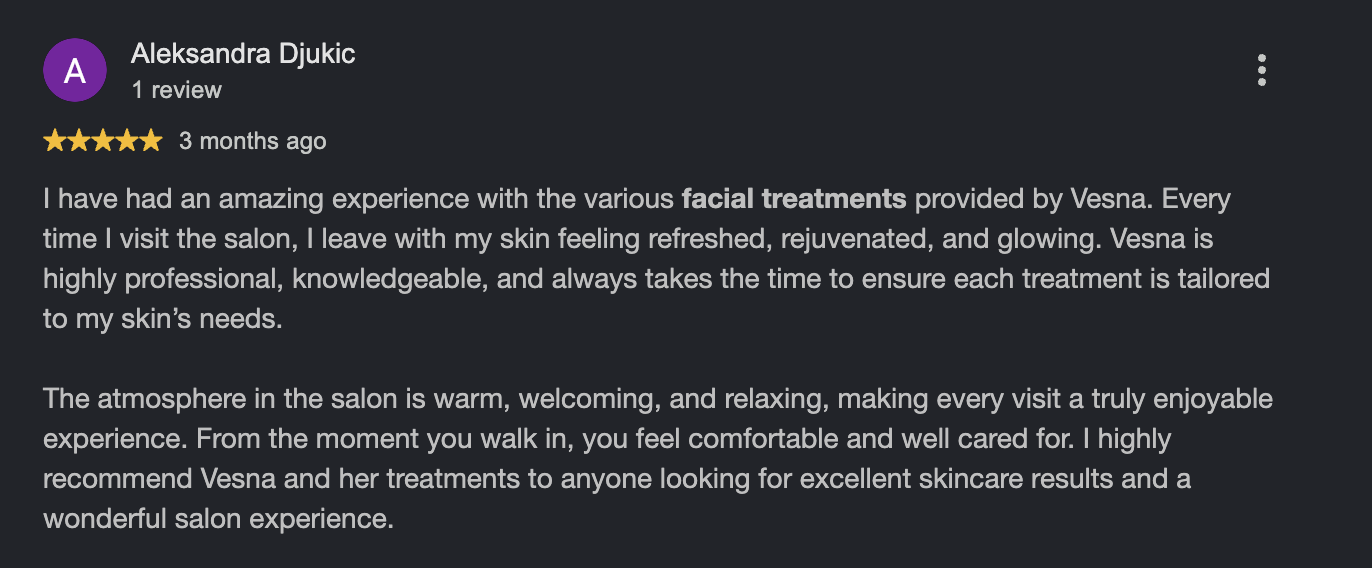
“Every time I visit the salon, I leave with my skin feeling refreshed, rejuvenated, and glowing.”
What a Vesna consultation can and cannot do
HydraFacial is a separate branded treatment, not another name for our Guinot facials. Murad’s description notes that it can cause side effects and may not suit everyone.[7] Ask the provider offering it about the specific treatment. If you have an existing skin condition, prescribed treatment, or a medical concern, we recommend checking with your treating healthcare professional before booking any salon facial. There is no pressure to buy a course or add products.
When medical advice should come first
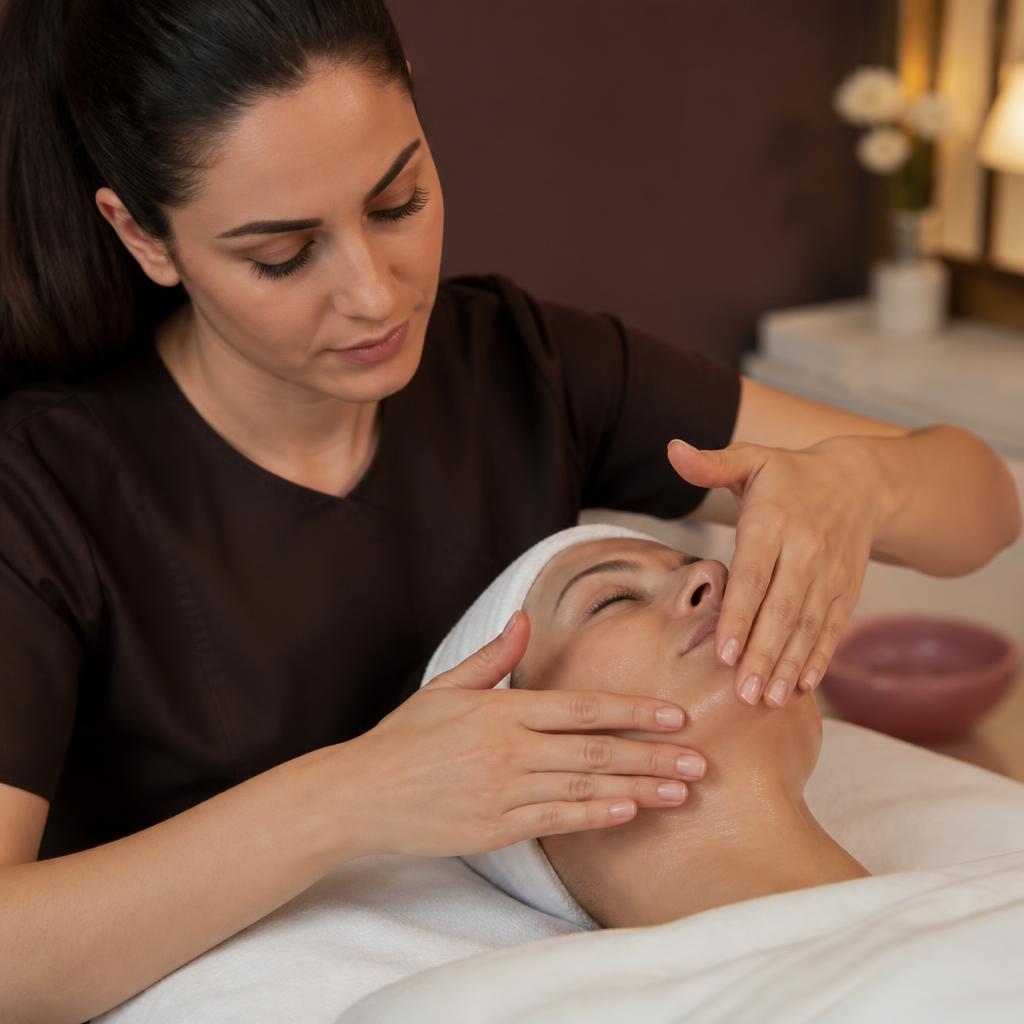
Start with a conversation, not pressure
References and citations
Guinot and Murad treatment descriptions remain attributed to their publishers, not independent proof of results. Medical and safety guidance is attributed to the AAD, FDA, and cited clinical literature. Post-Botox HydraFacial timing is one clinic’s guidance, not a universal rule. Vesna’s consultation recommendations are editorial service guidance, not diagnosis, individual medical advice, or an endorsement by a cited source. Google review excerpts describe personal experiences, not independently verified clinical outcomes.
- 1. Guinot: Hydradermie Treatment 1000
- 2. Guinot: Hydradermie Lift Treatment 1000
- 3. American Academy of Dermatology: Cosmetic treatment safety
- 4. American Academy of Dermatology: Best questions to ask when considering a cosmetic treatment
- 5. American Academy of Dermatology: What to look for: ABCDEs of melanoma
- 6. Vedamurthy, M. “Beware What You Inject: Complications of Injectables: Dermal Fillers.” Journal of Cutaneous and Aesthetic Surgery, 2018.
- 7. Murad: “Interested in a Hydrafacial? A pro shares the good, bad and ugly of the popular skin treatment.”
- 8. Harley Street Skin Clinic: “Why Hydrafacial After Botox Is the Ultimate Skin Reset.”
- 9. tanuja kothari: Google review supplied by the studio (excerpt quoted).
- 10. Nevine Meguid: Google review supplied by the studio (excerpt quoted).
- 11. Aleksandra Djukic: Google review supplied by the studio (excerpt quoted).
- 12. U.S. Food and Drug Administration: Dermal Filler Do’s and Don’ts for Wrinkles, Lips and More.
- 13. American Academy of Dermatology: Botulinum toxin therapy: Overview.
These reviews describe personal experiences, not independently verified results or a promise that a facial produces a medical facelift. The Botox comparison reflects the reviewer’s own account, not a clinical comparison between treatments.